展览频道
时间:2010年11月26日~2011年1月25日
地点:元典美术馆
地址:北京市朝阳区望京广顺北大街利泽西园112号
作品:18件,装置作品,雕塑作品
韩国的著名艺术家沈文燮11月26日在北京元典美术馆举办个展。该展览是沈文燮在北京的第二次个展。
作为韩国当代艺术最重要的艺术家之一,沈文燮不断地创作作品,在世界各地举办了展览。而且获到了2007年法国政府授予的 Chevalier勋章(文化艺术功劳勋章),2008年文信美术奖等。 他的作品中物质性很强,作品中的物质之间的关系与联合给我们一种崭新的感觉。
关于沈文燮的作品评论家黄笃在他的评论中写道“沈文燮的艺术观念主要强调的是主观经验与直接自然性,揭示其客观性与主观理念的并存。他并不追求在制作和形式上采取那种过分雕琢的手段,而是把未加工的物质与自然界的物体与人工化的物质以一定的手段加以联系,使其充分呈现出某种关系和自然状态,也就避免了人为定义化。”
“笼中之鸟”抑或“海中之鱼”的中国之旅——尹吉男
沈文燮先生是有自然观的。他对自然和现代化的理解构成他作品的主题。
新北京画廊是现代化大都市的“笼中之鸟”,林立的高楼大厦对这个古老的建筑造成了压力。由“土”和“木”两种元素构成古代建筑体现了古代的自然观。而周边的现代建筑正是用钢材、玻璃、水泥和灯光组成的。
沈文燮先生的作品中出现了两种材质的序列:木材、石头、水属于自然之物;钢铁、玻璃、灯光和电则属于人为之物。后者成为现代城市的基本物质。这些基本物质正以最快的速度覆盖着古都北京。当自然之物经过人为之后就有了人的精神,而人的精神又不知不觉成了自然的对立物。
艺术家好像通过个人的“人为过程”来反思我们集体的、现代化的“人为过程”。现代化的过程使更多的自然之物转化到人的世界中来,失去了原本的品质和美感,又创造了物质的奇观。 我们不断离开我们习惯的世界,这个世界和我们自己的动物性的肉身有更为契合的关系。
在沈文燮先生的个人经验中,穿越韩国和法国以及中国的物质世界的过程中,他的作品就像路标一样,清晰地记录了他的精神之旅。“笼中之鸟”的沉思和“海中之鱼”的希望成为他飞来北京的两扇精神的翅膀。
物之语,语之物 ——关于沈文燮的艺术观念
黄 笃
韩国著名艺术家沈文燮(Shim Moon-Seup)的作品大多以《反刍》(英语用Represent)为主题,而这一主题又充分反映了他的单纯而朴素的审美观。“反刍”的中文之意与英文“Represent”的内涵之间显然存在着一定的差异,英文的“Represent”有表现和象征之意。中文的“反刍”则是指“反刍动物把粗粗咀嚼后咽下去的食物再返回到嘴里细细咀嚼,然后再咽下。通称倒嚼。”因此,从汉语转译之意出发,它更能充分表达艺术家的观念诉求,这是艺术家的一种逆向思维,是一种基于这一思维的重新认识、理解、分析和创造。
他在对北京城市环境的考察中敏感地发现了材料(门板、柱子、砖瓦和石板)与记忆的关系,并通过对材料关系的再组合从而塑造出新的艺术语言。
这就使作品既与原物相似又不同于原物。 因此,我们可以在沈文燮作品中发现了三种与观念相关的特征:一是依据与语境(context)的关系建立和创造作品的观念意义。例如,他曾对新北京画廊空间的考察中就觉察,它是一个明代粮仓建筑,至今仍保存完好,然而,它的位置与现代的都市发展形成巨大反差。他巧妙利用了这种对比的契机,将被现代城市遗弃之物(木头、木工夹)与画廊室内建筑结构的结合,生成了一种既陌生又熟悉的艺术语言。例如在作品《反刍》(木头、木工夹子)中,他根据空间将木头和木工夹子安装/固定在白色柱子上,正是这种物质组合的关系激活了人的记忆、想象、沉思。而他的《笼中之鱼》则是在两个柱子之间营造了一个大的“笼子”,把无用之物的再使用,并与存在之物的重新建构,形成了主体与原素的和谐性。二是沈文燮擅长运用不同物质的结合,从而创造出某种自然状态与人工状态的新关系。他把木头与石头的关系处理成带有质朴而自然的美感,尤其符合人的身体要求,这也许与韩国家庭或餐馆中木制餐桌规定的人的身体坐姿有关,也就更接近人的日常经验和生活美学。又如他还把木头与钢、木头与玻璃之间相遇,确立了生成的语言张力。在这种不同物质构成的新的关系中,木头是一种自然生长的植物,而钢和玻璃则是一种工业化的进化材料,它又是自然的反进化的味道。正因为它们的物质聚合才使其释放或暗示出消耗的能量。三是在艺术与非艺术、逻辑与反逻辑、形式与反形式中建立一种新的艺术观念,一些物质材料石头、光纤、水、木头钢板等本没有内在联系,但艺术家正是通过这些材料的关系、矛盾及“形式之前的形式”创造出超出人的想象之外的另一种物质的“生命”形态。
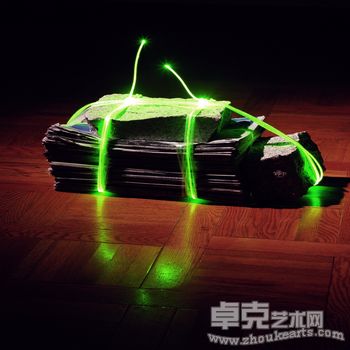
2010年,沈文燮受北京今日美术馆邀请参加了《调节器:第二届今日文献展》(Negotiations: The Second Today’s Documents 2010),他创作的两件装置作品都取名《反刍》。 在以报纸、光纤、灰砖、盛水盆而组成的《反刍》中,他有意用光纤把《北京青年报》、《中国健康报》以及其它报纸各捆绑在一起,随意摆放在地面上,流动而萦绕的光纤发出绿光,其旁不规则的放着一些零散的灰砖。
于是,在这样的物质关系中,报纸传递信息包含了社会、政治和日常信息,而看似静态的缠绕每捆报纸的光纤发出绿光则暗示了鲜活而动感的状态。显然,沈文燮着重强调的是关系与表现的方法,其观念核心的并不是对材料的创造,而是把材料的关系理解成它们的联合所产生的意义。
在由竹子、光纤、电形成另一件装置《反刍》中,他特意根据美术馆巨大的空间尺度用竹子制作成了一个黑色长柱状的笼子,斜横悬挂在大厅中央,一条发出绿光的光纤从笼子中心穿过,它与其说是一个雕塑,倒不如说更像是一个建筑物。它负载了沈文燮对儿时游戏记忆的迷恋和放大,对传统文化中虚空与存在的形象隐喻,对特定空间的介入和干预,这一切最终形成了与存在之物(其他艺术家作品)之间的对话和协商的和谐关系。
沈文燮非常关注对物质、场域和人三者关系的解析,并通过艺术形式来再现物与人之间的关系状态,他并没有刻意去表现一种绝对的物质,而是试图将物质在自然状态,人为干预,场所情景中揭示它们的内在关联,既能表现出自然的本来状态,也暗示人为的意念,更能以空间和物质的关系来定义物的修辞。
沈文燮的艺术给我们以很大的启发性——当人的意识是所有存在的基础时,意识就创造了世界存在。换言之,艺术家的观念就在于把人的理念融入自然,而不是与自然对抗。他对物质极其结构的关注,并不是要表现作为一种绝对物的物质原义,而是试图将存在于情景、时间、空间、运动、位置和因果关系中的物质状态以及与之相关的意义展示出来。
沈文燮的艺术观念主要强调的是主观经验与直接自然性,揭示其客观性与主观理念的并存。他并不追求在制作和形式上采取那种过分雕琢的手段,而是把未加工的物质与自然界的物体与人工化的物质以一定的手段加以联系,使其充分呈现出某种关系和自然状态,也就避免了人为定义化。正如铃木大拙在《禅与日本文化》中精辟的论述:“禅的心性,就是破除一切人工的形式,真正把握住其背后隐藏着的精髓。正是这种心性,哺育着日本人牢记大地、亲近自然,不断品味那不加任何雕饰的浑朴”。基于这样的东方哲学,在艺术理念上,沈文燮追求与物的“相遇”,实质上是关于人对物的尊重和心灵对物的关照,也就是主客观的统一。在表现媒介上,摒弃固定的表现物质,而采用日常的原始的自然物质或工业材料。在艺术表现上,把握存在的形式与人的心灵的关系。
沈文燮的美学核心强调的是纯粹经验,也就是按照事物的原样感知,强调主观和客观的合一,在主观意识与客观物质的“相遇”时,通过不断发现物质的内涵和意义来表现物质的“原始状态”、“生成”、“转化”,进而找到与自然物质的相遇的相关性,目的在于揭示进入不可见的世界以及见之所未知的世界。
黄笃(Huang Du)是一位在北京生活和工作的独立策展人(independent curator)。他的主要策展有:2006年《第六届上海双年展》,2007年《首届今日文献展》,2008年《第三届南京三年展》和2010年《第二届今日文献展》等。
The language of objects through an objectifying language – on the artistic concepts of Shim Moon-Seup
Huang Du
Acclaimed Korean artist Shim Moon-Seup’s work primarily focuses on representation of fully embodying his simple yet humble aesthetic values. It’s obvious that the meanings of representation are different in Chinese and English. In English, to present means to symbolize, to express. Whereas in Chinese, “represent” also refers to ruminant animals that chew on the cud what has already been stomached, also known as regurgitation. Thus, the Chinese translation is even more effective in expressing the artist’s conceptual pursuit, an approach of reverse thinking, which allows further learning, understanding, analysis and recreation.
Through his research on Beijing urban environment, the artist has discovered the relationship between materials (door planks, pillars, tiles and bricks) and memories, and his reassembling of materials allowed him to create a new body of artistic language. The artworks, as a result, resembles to the original objects with remarkable differences. We discover the three conceptual characteristics in Shim Moon-Seup’s work: first of all, the establishment between emblem and context in relation to the conceptual meaning of the artwork. For example, he has noticed that the architecture of a well-preserved Ming dynasty crop storage of the former Xin Beijing Art Gallery that contrasts drastically with its surrounding urban developments. Shim appropriates such contrast, reassembled the abandoned modern urban objects (wood, carpenter’s fixtures) with internal architectural structure of the gallery to render an artistic language that is unknown yet familiar. For example, the work Representation (wood and carpenter’s fixture), Shim has installed the wooden pieces and fixtures on the white pillars in the space, the relational aesthetics of these objects reactivates people’s memories, imaginations and contemplation. Moreover, his Caged Fish consists of building a large “cage” between two pillars, and reuses certain abandoned objects to establish a new relationship with what’s existing so the main object harmonize with other original elements. Secondly, Shim Moon-Seup excels in combining different materials, from which to create new relationships between its natural and artificial state. He bequeaths the rocks and wood with its own natural and humble aesthetic beauty that responds to human physical needs, perhaps it’s related to the sitting positions in Korean families and restaurants – a context that brings us closer to our everyday experience and aesthetics. Just as his introduction of wood and steel, wood with glass – creating a linguistic artistic tension. In the formation of these different materials, wood is a natural element, whereas steel and glass are developed industrial materials that symbolize anti-evolution. With this assemblage of materials, could the energy exhausted be released and symbolized. Thirdly, the new artistic concept established through dichotomies of art and non-art, logic and anti-logic, form and anti-form. Certain materials such as stone, optical fiber, water, wood and steel plates have no intrinsic relationships, yet the artist creates another form of life for materials beyond our imaginations through these relationships among the materials, their contradictions and “formal forms”.
In 2010, Shim Moon-Seup was invited to participate in Negotiations: The Second Today’s Documents 2010. The two installation works on display were both entitled Representation. The work consists of news paper, optical fiber, grey bricks, water basin, the artist bounds stacks of magazines such as Beijing Youth, China Health together with optical fiber, and placed on the ground randomly, the fluid and lingering optical fiber emits certain reflections, next to it are randomly placed grey bricks. In this relation between the objects, the meaning symbolized by the newspaper embodies that of society, politics and everyday information, where the optical fiber and the lights it reflects highlights the dynamics. It is apparently that Shim Moon-Seup focuses on emphasizing the approach to relations and representations of objects, rather than to creating materials, he produces meaning through the organization of relationships among them.
The other work consists of bamboo, optical fiber and electricity. According to the spatial dimension of the museum, Shim has produced a cylindrical cage with bamboo, and hung it with a slant in the center of the gallery. An optical fiber emitting lights passes through the center of the cage. Rather than considering it as a sculpture, it’s better to look at it from an architectural angle. It carries Shim Moon-Seup’s infatuation and nostalgia on childhood memories, allusions to the fictional and existing traditional culture, intervention to a specific space, all of which initiates a dialogue with the existing objects in the space (in other words, other artworks on exhibit).
Shim Moon-Seup is interested in the deconstruction of the relationships between materials, context and people, in order to represent the relational status between people and objects through artistic forms. He does not ostensibly try to represent an absolute material, but to unveil their internal relationship as the objects are located in its natural state, under human intervention or in specific scenarios – an approach that both allow the natural state to be revealed, as well as redefining adjectives to materials through its relationships with its given space.
Shim Moon-Seup art inspires us – as the human conscience is the basis for all existence, conscience creates the world that exists. In other words, the artist’s concept is to infuse the idea of men into nature, rather than acting against nature. His interest in materials and their structures are not to represent the original forms of the object alone, but to reveal the meaning and state of materials in scenarios, time, space, dynamics, positions and causalities in which they exist.
Shim Moon-Seup’s artistic concept mainly focuses on subjective experience and the natural state of existence, unveiling the coexistence of objectivity and subjectivity. He is not interested in the over-adorned forms, but to create rapport between the unprocessed material in their natural and artificial state, in turn to allow them embody certain relationships and natural state effectively, by the same token avoiding artificial definitions. Just as D.T. Suzuki’s incise analysis in Zen and Japanese Culture, “The core of Zen is to efface all artificiality, while trying to grasp its hidden essence. It is this state of mind that nurtures the Japanese to remember their land, approach to nature, and reminisce at the unadorned humility.” With such Eastern philosophy in mind, Shim Moon-Seup’s artistic concepts pursue an “encounter” with objects that in reality reflect upon people’s respect for objects, and our spiritual connection to them - in other words, the unity of subjectivity and objectivity. In terms of medium of representation, by abandoning given symbolism of objects, the artist choose to use everyday, original and natural or industrial material. In his artistic representation, he excels in manipulating the relationship between form and people’s spirit.
The core of Shim Moon-Seup’s aesthetic emphasizes on pure experience, in other words, to sense the originality of the objects and the unity of the subject and object. As subjective conscience “encounter” objects, the artist represents the “original state”, “formation”, “transformation” of the material through constantly rediscovering its embedded meaning in order to further seek relationships with natural objects. His primary goal is to unveil the unfamiliar world, as well as the unknown before our eyes.
Huang Du is an independent curator living and working in Beijing. Major exhibitions curated include, The 2006 Shanghai Biennale, The First Today’s Documents in 2007, The Third Nanjing Triennale in 2008, The Second Today’s Document in 2010.
上一篇展览:《执拗》吕岩作品展
下一篇展览:自在的玩物—于幸泽绘画作品展
E_mail:zhkarts@vip.163.com 客服电话:18156032908 18155173028 18956011098
版权所有:卓克艺术网 Copyright 2005-2018 zhuoke.cn, All Rights Reserved.
合肥美网文化传播有限公司ICP皖ICP备09018606号-1 皖公网安备 34010402700602号
企业法人营业执照互联网域名注册证书安徽省通信行业暨互联网协会会员单位中国互联网举报中心
客服电话:18156032908 18155173028 18956011098
©2005-2018 zhuoke.cn ICP皖ICP备09018606号-1