展览频道
Art director: Yang Shu艺术总监:杨述
Curator: Ni Kun策展人:倪昆Assistants: Li Xiaoxi Lin Miao策展助理: 李小溪 林苗
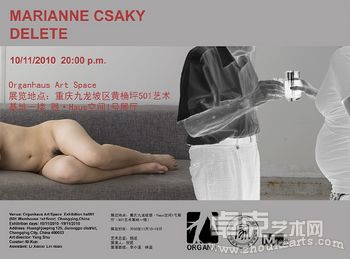
Artist: Marianne Csaky(Hungary)
艺术家:Marianne Csaky(匈牙利)展览开幕时间Opening: 10/11/2110 20:00 p.m.
展览时间Exhibition days: 10/11/2010—19/11/2010
展览地点:器·Haus空间1号展厅(501艺术基地一楼)
Venue: Organhaus Art Space exhibition hall #1(501 warehouse 1st fl)
地址:重庆九龙坡区黄桷坪正街126号501艺术基地三楼 杨述工作室
Address: Organhaus Art Space (first floor, 501) Huanghjueping 126, Jiulongpo district
Chongqing City China 400053
Web: http://www.organhaus.org
E-mail: organhaus@163.com organhaus@gmail.com
器空间驻留工作计划
我的计划中最重要的部分是关于历史和记忆,用拍电影和照片的手法来表现不同地方的同一个场景,这个场景以当地人不同的个性和文化为背景。但是,我把文化背景这个概念作为一个非常个人化和复杂的现象,而不是自动的和唯一性的定义为一个确定的地理位置或国家的概念。这个项目开始于布达佩斯,然后在2008年我继续在韩国首尔花了3个月时间做了这个驻留项目,然后在2009和2010年又到了云南昆明的943工作室做了4个月。我希望在重庆器空间能继续这个项目。我的另外一个目标是有一个丰富的、理论性的和个人性的对话,这个对话包括驻留项目、作品和概念,把我的作品和其他艺术家的作品放在一个新的、范围更大的,同时又是跟个人作品上下文有关的环境中来讨论。
在器空间驻留期间,我希望能够调查这些问题,用我的旧电影和移动影像技术来继续做为“时间飞跃”这个系列的制作方法。它的原始资料是古时欧洲(匈牙利)的自制(家庭)电影。2010年1月在昆明我拍摄了一些系列剧照,让我的中国同事和朋友们在他们的理解下表演原始现场。我希望能在重庆跟当地的艺术家和居民继续这个项目。每个人有不同的个性、观点和个人背景,在这个原始现场中会有一个或更多的转换的自我意识。除了这些镜头,我还想拍摄一些人们基本的手势、交流和联络。在这个计划中,与大家一起思考和工作的过程跟作品的结果一样重要。这种工作方式可以增加阐释和再阐释的过程的新的方面,通过这种方法,可以提供对固有观念和意象的纠正和解除。我的目标是进行实验:怎样将心灵、精神和智力的基本概念和要求变得普遍和独特,同时如何建构我们对于自己和我们对世界的想象,使之跨越文化,跨越时间,但始终跟主观性有关。
这个项目的实现将是在展览场地内有一个特定的空间的一个特定场域的装置。
详细的描述上面这个作品,需要跟当地人进行交流,找到跟他们的生活有关的,从中学习,并让他们明白我从他们那里需要什么和我可以回馈给他们什么。为此,我将需要一个机会去接触当地人,来解释我的作品、内容和在我的艺术中所遇到的问题。从这个意义上说,也包括在我的作品中,他们的照片、他们的记忆和他们的影像,将参与到这个作品的过程中。考虑到这个方面,创作出的这个作品是一个团体结果。个人的记忆、环绕的都市风景、个人的介入使得照片和影像成为建立新的叙述、新的现实和变得更加能够意识到世界并非只有一个真实而是有很多个的结果。
现行方法
历史和个人的记忆,身体和表现,欲望和主观,和心灵、想法、身体最基本和亲密的圈子里,在社会的、历史的和理论上的语境都是我感兴趣的方面。我试着去揭示这些因素是怎样一起起作用来定义和再定义我们在世界上的位置,作为个体、家庭成员和社会、历史学科和历史制造者的不同角色。我们记忆中的角色是什么呢?怎样重写记忆和改变构造自我的欲望?这是我的艺术中主要探寻的问题。
我最近的作品是“时间飞跃”系列,针对的是小群体里的过去的历史和
个人。在这些作品中我的目的是想要抓住通过家庭的叙述来构建个人身份的过程。我尝试着去揭露记忆和历史的变化和不稳定的特性。基于上世纪60、70年代的照片底片,我的“时间飞跃”系列作品分析了我们每天的联系和努力去重写过去和通过这么做来改变我们我们的现在。
在第一个阶段,对于过去的介入是通过建立一系列“灯箱”来完成的,保持最初大尺寸底片的媒介和大小。我最近开始涉及到用分色摄影的方法把原版底片变成另外一个时间方向分层和解构原来的内容。由于这个原因,原版底片作为一个媒介代表了我说不清楚的过去、终极(根本)材料,更确切的说,是解释或叙事改编之前的真实。(但是拍照片这个行为本身是解释)然而,通过操作这些底片,我想要作品涉及到 人们怎样置换记录、解构个人所保留的记忆、改变他们的过去和保护现在的他们自己的过程。
“时间飞跃”系列作品的第二个部分是一系列装订照片。这又是一次对过去的介入——更确切的说,是介入在当下的过去。我最近会做一些从录像中来的来的静态影像,描述的主题(我自己)在孤独的性欲情形下,把爱置于一种没有这种欲望的位置。影像上丝织物来自相同系列的老照片。我用性别参考这些图像用来作为一种主观的转喻,欲望的语言作为构成我们“自己”的整体。当“灯箱”通过放置我在这些影像中的现在的自己来重写过去,在这个系列中相反的事情出现了:家庭历史中的任务出现在我的现在、观察我的情形,主动的参与进他们自己和我现在的情境中。
后来的2009年作品“分身术”是我在08年在韩国首尔拍的。在这些作品中,我把重点放在从不同的个人经验、不同的个人和集体的历史以及文化背景来表现不同的观点和阐释。
作品取自旧电影中的5个画面,来自拍摄的欧洲某处的一个家庭聚餐。这个电影描述了在一个亲密的但有紧张的情境中无意识的、无组织的场景,在另一个图层,用素描添加另外一个角色,一个年轻的韩国女人,她扮演了好像她进入到过去的场景但是同时莫名其妙的又始终阻止她自己进入这个场景。
作为艺术家的密友,她不仅被卷入到对图像中发生的事情保持观看和反应的原始状态。并且不但通过她的观看,而且通过素面这红不同的媒介,她与原初的图像保持距离。照片和素描这两个层面上的角色,我只能说,是从不同的方面、不同的位置看着同样的情境。
Marianne Csaky:
Application for the Organhouse Art Space Residency Programme in Chongqing.
Work plan
The essential part of my project about history and memory is filming and photographing the same scenes in different places with local people with different personal and cultural backgrounds. However, I use the notion of cultural background as a very personal and complex phenomenon that is not defined automatically and exclusively by a certain geographical location or nationality. I started this project in Budapest then I continued the work in Seoul, South Korea where I spent 3 months in a residency program in 2008, then in Kunming, Yunnan, China where I spent 4 months at the 943Studio residency program in 2009/2010. I would like to continue this project at Organhouse Art Space in Chongqing. My other goal is to find a rich artistic, theoretical and personal dialogue about projects, works and concepts, putting my work and the work of other artists in a new, wider and, at the same time, personal context.During my residency at Organhouse I would explore these questions by manipulating old videos and moving images continuing the method of Time Leap series. The source material is an old European (Hungarian) home movie. I re-shot some sequences and stills of this movie in Kunming, China in January 2010, asking my Chinese colleagues and friends to perform the original scenes in their interpretation. In Chongqing I would continue this process with the local artists and local people. Each person in the original scene will have one or more alter egos with different personality, different points of view and different personal backgrounds. Besides these footages I would like to shoot sequences on basic human gestures, interactions and communications. In this project the process itself, thinking together and working together with others, is as important as the result. This way of working can add new aspects to the process of interpreting and re-interpreting and, by this means, it also provides remedy and release from fixed notions and images. My aim is to experiment with how the basic concepts and desires of the soul, the mind and the intellect are universal and unique at the same time, and how the way we construct ourselves and our vision of the world are relevant across cultures, across times and still subjective. The realization of this project will be a site specific installation of the animated video based on the spatial characteristics of the exhibition room.
Making the works described in detail above would require communication with local people, finding out about their lives, learning from them, making them understand what I need from them and what I can give them in return. For this, I would need a chance to meet local people, explain my work, the context and the problems I focus on in my art. In this sense, and also in the sense of including in my works their photos, their memories, their images, they would participate in the work process. Considered from this aspect, the works that are created would be the results of community. Personal memories, the surrounding cityscape, personal involvement in making the photos and moving images would result in building new narratives, new realities, and becoming more aware of having not just one reality but many realities.
Current practice
History and personal memory, body and representation, desire and subjectivity, and the most basic and intimate spheres of the soul, mind and body in a sociological, historical and theoretical context are in the focus of my interest. I try to reveal how all these factors work together in defining and redefining our position in the world, the different roles as individuals, members of a family and of society, subjects of history and also makers of history. What is the role of our memories, and how the re-written memories and shifting desires construct the self of a person? These are the main issues explored in my art.
My recent work, the Time Leap series focuses on the relations of small community history and personal past. In these works my aim was to grasp the process of constructing the identity of the individual through the family narrative. I attempt to reveal the changing, unstable nature of memory and history. Based on the negatives of photographs taken in the 60s and 70s, my Time Leap series is the analysis of our every day practice and effort to rewrite the past and, by doing so, to change our present.
In the first stage, this intervention in the past was achieved by building a series of light boxes keeping the original medium and size of the large format negatives. I inserted my figures from colour shots taken recently into the original negatives creating another time layer and deconstructing their content. In this context the original negative as a medium represented for me the inarticulate past, the documentation of ultimate, or rather, original truth before interpretation or narrative reorganization. (However, the act of taking a photograph itself is interpretation.) Nevertheless, with the manipulation of these negatives I wanted to refer to the process of how people displace records, deconstruct documents preserving personal memories, to change their past and to protect their present selves.
The second group of works in the Time Leap series is a series of stitched photos. This is again an intervention in the past – or rather, an intervention of the past in the present. Some of the still images are from video recordings I have taken recently, depicting the subject (myself) in a solitary state of sexual desire, situated in positions of love acts without an object of this desire appearing in the images. The silk figures sewn on the images are from the same series of old photos. I use the images with sexual references as a metonymy of subjectivity and the language of desires as a whole that constitute our “self”. While the light boxes rewrite the past by placing my present self in those images, in this series the opposite occurs: figures from family history appear in my present, observing my state, participating actively both in the situations of their own and my present.
In the subsequent work, Bilocation, 2009, I used shots taken in 2008, in Seoul Korea. In these works I put the emphasis on the representation of different views and interpretations from the different personal experiences, different personal and collective history and cultural background.
The pieces based on 5 pictures taken from an old celluloid film which was shot somewhere in Europe in a family reunion. The film depicts spontaneous, unarranged scenes on an intimate and also tense situation. The other layer of the pieces, the charcoal drawing adds another character to the scenes, a young Korean woman who acts as if she took part in the original scene but in the same time somehow she still keeps herself outside of the scene.
As the artist’s alter ego, she is involved in the original situation, keeps watch on and reacts upon what is happening on the pictures. But also by her gaze as well as due to the different medium, the charcoal drawing, she makes a distance from the original scene. The characters of the two layers, the photo and the charcoal drawing, look at the same situation from different aspects, I can say, from different places.
Marianne Csaky
上一篇展览:「印象派及现代大师画作」特展、「现代及当代艺术」拍卖傳媒预展
下一篇展览:秋日拾夏(别尔纳茨基个人油画展)
E_mail:zhkarts@vip.163.com 客服电话:18156032908 18155173028 18956011098
版权所有:卓克艺术网 Copyright 2005-2018 zhuoke.cn, All Rights Reserved.
合肥美网文化传播有限公司ICP皖ICP备09018606号-1 皖公网安备 34010402700602号
企业法人营业执照互联网域名注册证书安徽省通信行业暨互联网协会会员单位中国互联网举报中心
客服电话:18156032908 18155173028 18956011098
©2005-2018 zhuoke.cn ICP皖ICP备09018606号-1