展览频道
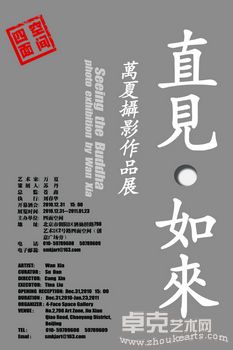
艺 术 家:万 夏
策 展 人:苏 丹
执 行:刘春华
展览时间:2010年12月31日——2011年1月23日
开幕酒会:2010年12月31日(周五)下午3点
展览地点:四面空间
地址:中国•北京市朝阳区酒仙桥路798艺术区2号路创意广场旁
邮编:100015
电话:010-59789608/59789609
邮箱:smkjart@163.com
网址:www.art4m.org
Seeing the Buddha——Photo Exhibition by Wan Xia
Artist:Wan Xia
Curator: Su Dan
Executor:Tina Liu
Duration: Dec.31st,2010 —Jan.23rd,2011
Opening reception: Dec.31st,2010 15:00
Exhibition Venue: 4-Face Space Gallery
Address: No.2 Road 798 Art Zone Jiuxianqiao Road Chaoyang Distrist
Beijing China
P.C:100015
Tel: 010-59789608/59789609
E-mail: smkjart@163.com
Website: www.art4m.org
万夏:穿透万象
方振宁
“万象”一词被释义为宇宙间一切事物或景象。那么为什么要“穿透万象”?
当万夏在手机的那一边,回答我问的“你的创作动机是什么?”时,他说他已经抄写《金刚经》有十几遍了,打算要抄五十遍。那么万夏抄《金刚经》的意义在哪里呢?
于是万夏引用了《金刚经》中最为精彩的一段:“世界,非世界,是名世界。”“凡所有相,皆是虚妄。若见诸相非相,则见如来。”来解释他对世界的认知。然而用电话来传播一段文言,显然不是一种最佳的形式,于是万夏操着一口有川腔的普通话,把《金刚经》中的佛告须菩提这一段翻译成白话传达给我,于是听者的我豁然开朗。原来《金刚经》说的是,所有你能看到的世界,都不是真实的世界,万物的表象只是一种虚幻的假象,如果你视万象为虚幻的假相,那么才能获得对真实世界的到达。
我们可以释译一下“摄影”一词,它是由“摄”和“影”两个字组成的词,直译就是捕捉影像,所以摄影是在世界没有发明摄像之前,成功的捕捉世界表象的先锋性工具。它使我们借助平面的媒介,回忆我们的眼睛所看到的东西,准确地说,是固定了我们的视觉所曾经有过的视觉经验。那么还有什么能比摄影更能说明表象和真实的关系吗?如果你只是通过摄影来了解世界,那么它就是地道的表象。
认识到此,那么在虚幻的摄影上打孔,就成为一种鲜明的认知。谁也不知道很多年来,万夏这位诗人和出版人还有着另一个艺术家的身份。万夏十多年来有意无意地疯狂拍摄,也没有人会想到他会像一匹黑马杀到视觉艺术的世界中来。
其实所有的话题,都是从我写这篇拙文的三天前开始的。艺术家苍鑫把万夏和我带到离798不远的五环外他的工作室聊天,无意中万夏说到他手里有一批摄影,他描述了一下作品的状态,我和苍鑫凭直觉,都对这批还没有看到原作的作品感到兴奋。一致认为应该拿出来展览和传播,形式就是赶快办一个展览,结果就这么定了。当我还没有看到原作时,也答应了为这本画册写几段文字。当我真的在几小时之前看到这些作品时,吃惊了。于是冲动地写下了这篇短文。你看,直觉就是这么灵。无论是万夏的作品,还是我们的直觉,都是穿透万象直见如来的行为。
2010年 平安夜前夕
北京后现代城
直见如来——万夏摄影作品展
2010.12.31
Seeing the Buddha——Photo exhibition by Wan Xia
世界,非世界,是名世界。
凡所有相,皆是虚妄。
若见诸相非相,则见如来。
——《金刚经》
视觉的“延异”
鲍昆
如果将摄影也看作是一个具有哲学意义的文本,那么它也存在一个“延异”的话题。
所谓“延异”,是德里达发明的词汇,指的一切文本都是模糊的、未定的,是不明晰的,一切文本的“本原”只是当下的。
视觉的本质是随着时间流逝中的“历时性”活动,但摄影却是一种“间断”时间的活动,把时间变成了空间,而且它是以框型的结构关系重新赋予和规定了我们视觉观看的意义。我们很多年对于摄影的理解是从这一点出发的,并把摄影等同于视觉。其实两者根本就不是一回事。
视觉的历时性特征需要历时性的表达,才能再现视觉和视觉之后的意识活动。这个过程正好和德里达“延异”的意指具有一定的同构性。但摄影作品“在者”的即时性呈现却好像和视觉的历时性存在着不可重合的矛盾。
万夏的摄影展览,是他每一次单元性的视觉过程呈现,那些拼贴的作品正是他曾经在看一个个场景时游移的目光再现。他以这种方式挑战了我们一贯认知的摄影意义,探寻视觉本身和摄影之间的关系。在他的这个挑战(实验)中,瓦解了摄影曾经给我们强加的固定意义。他也从一个角度上告诉我们,我们总爱说“摄影”如何,但实际上“摄影”是不可说的,尤其是我们把摄影等同于视觉的时候。我们不能在摄影之中说摄影,只能说视觉是什么。
万夏还不满足用摄影再现视觉,他还希望洞穿依附在纸上的视觉遗迹影像,寻找视觉后面的意义。那些粗暴地贯穿在“作品”之上的孔洞,就是万夏质疑“视觉”的目光。空洞后面是什么呢?或许,佛可以回答。其实,正如德里达所云,一切都是延异的。
2010.12.22
The Differance of Vision
Dec 22, 2010
BAO Kun
If a work of photograph is regarded as a text with philosophical
meanings, it can also involve the topic of differance.
Differance, a term coined by Jacques Derrida, points out that all
texts are vague, indefinite and unclear and the ‘origin’ of all texts
can only be present.
The essence of vision is the diachronic actions that flow away with
time. Photography, on the other hand, is an activity that interrupts
the flow of time and thus translates time into space, which, with the
structural relations of frames, re-assigns and re-defines the meanings
of our vision. For decades, we have always understood photography from
this perspective and equated photography with vision, but they are not
the same at all.
In order to represent vision and the activities of consciousness
behind vision, the diachronicity of vision requires diachronic
expressions. This process happens to be somewhat isomorphic with the
idea of Derrida’s differance. But the punctual representation of a
photographic work as a being seems to pose as an irreconcilable
contradiction to vision’s diachronicity.
This photo exhibition by Wan Xia is a representation of each of his
atomic acts of visual process. These works of photo collages are the
representations of his moving eyes when he was looking at the scenes.
It is in this way that he challenges the meaning of photography that
we have always perceived. In this experimental challenge he liquefies
the fixed meanings which were once imposed upon us by photography. He
tells us from one angle that we always talk about photography but
photography is actually unspeakable, especially when we equate
photography with vision. We cannot talk about photography in
photography, but can only say what vision is all about.
Wan is not satisfied with just representing vision with photographs,
but also would like to penetrate the traces of visual images left on
the paper in search of the meanings beyond vision. Those holes that
brutally penetrate his works are actually his eyes that question
vision. What is behind those holes? Maybe the Buddha has the answer.
In fact, just as Derrida put it, everything is differant.
上一篇展览:肆意与妄为
E_mail:zhkarts@vip.163.com 客服电话:18156032908 18155173028 18956011098
版权所有:卓克艺术网 Copyright 2005-2018 zhuoke.cn, All Rights Reserved.
合肥美网文化传播有限公司ICP皖ICP备09018606号-1 皖公网安备 34010402700602号
企业法人营业执照互联网域名注册证书安徽省通信行业暨互联网协会会员单位中国互联网举报中心
客服电话:18156032908 18155173028 18956011098
©2005-2018 zhuoke.cn ICP皖ICP备09018606号-1