展览频道
策展人:赵松
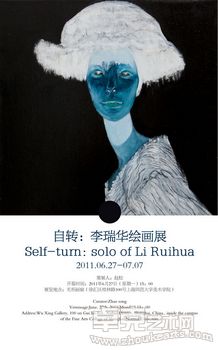
开幕时间:2011年6月27日(星期一)15:00
展 期:2011年6月27日——7月7日
展览地点:无形画廊(徐汇区桂林路100号上海师范大学美术学院)
Curator: Zhao song
Vernissage: June. 27th, 2011(Monday) 15:00
Duration: June. 27th –July.7th
Address: Wu Xing Gallery, 100 on Gui lin Rd., Xuhui District, Shanghai, China., inside the campus of the Fine Arts Collage of Shanghai Normal University
“自转是指物件自行旋转的运动,物件会沿著一条穿越物件本身的轴进行旋转……”从某种意义上说,跟行星一样,社会中的人也有其生命轨道,所不同的是,人的生命轨迹要比行星的更难观测与描述。对于他者而言,一个人的生命轨迹无论简单还是复杂总是充满了神秘难料的意味。同行星一样,人也有属于自己的自转过程。也正是这样的自转,使得人的多面性以不断变化的方式持续呈现。自转使得人的不同自物面与世界发生不同的对应关系,于是多面性的人与多样化的世界在不断的互动状态下注定会制造变幻不居的现象与图景。为此艺术家所要做的不仅仅是敏锐地发现这样的关系的微妙与丰富,更为重要的是从中提炼出种种活性因素,并在有限的画面空间中构建独特的镜像,以传达自己对世界的认识、理解与无限想象。李瑞华的绘画作为一种尝试,其价值就在于不仅要通过翻转视界来表达对那些非日常性领域纷繁瞬间的洞见与把握,还要借助对具有生成性的变幻图景的多重构建来映射作为个体的人对日常现实中的模糊地带的执著探索。从这个意义上说,她的“自转”也正是艺术家自我发现、展开与不断丰富的真正起点。
自转:自我与他者的临界意象
关于李瑞华的绘画艺术
赵松
如果我们说,日常的视界总是给人们以太多的习惯性错觉,那么显然,其根源在于很多时候人们其实是“视而不见”。这样的例证数不胜数。在现实中,人们时常在看着什么,但假如让他有所描述的时候,多数人会陷入近乎失语的状态,或者只能对事物进行最简单意义上的代词性、名词性加动词性的描述。照相机和录像机普及的时代里拍摄行为之所以会如此的风靡,主要原因就是人们总是近乎本能地要把自己看到的事物留存下来,以便于证明自己曾经看见了什么。然而悖论的是,人们所拍摄下来的静止或流动的日常图像,大多数情况下仍旧不过是他们“视而不见”的证据。你会发现,作为观看/拍摄主体的自我与作为被观看/拍摄客体的他者差不多在图像生成那一刻起一起隐没了,留下的只是主客体均无法在场的现场而已。他们的看是群体意义上的,而不是个体意义上的,更准确地说是程式化的而非个性化的,说到底很多时候他们都无法自在地看见什么,只能看到人人都能看到的那些东西。
从这个意义上说,真正的艺术家与普通人的根本区别不在于他们掌握了某种艺术的技巧,而在于他们拥有发现的眼睛,他们能看到普通人看不到的“真相”,同时又能以自己的方式将这种“真相”的发现转化为艺术的存在。他们总是能够通过构建另外的别样的视界折射出现实存在的瞬间性与丰富性。他们是发问者,关于如何去看,如何看见,如何在看见的过程中有所发现,更主要的,是关于何谓自我与他者的存在,以及在这个近乎无限的现实世界里有限的自我与他者深陷其中的纷繁关系以及由此而生发的种种现象。所以真正的艺术家总是离世界最为切近的人,总是能对自己的处境有最深刻的体验与描述的人,他们总是在努力更为深入地观察认识世界的过程中清楚地意识到自我的存在与界限,同时小心地将自我隐藏在作品的深处。而当人们面对他们的作品的时候,所看到的永远是现实中从未存在过的视界,因此也就意味着人们无法以经验的眼光来进入其中,体会深藏其中的奥秘。只有人们能够以清晰的主体性自我来面对那些作品、并且意识到他者的主体性存在状态的时候,作品才会自然而然地显现其真实的面目,成为自我与他者的视界交汇的场域。
作为一个年轻的艺术家,李瑞华的艺术道路正处在初步形成和稳步延伸的阶段,在很大程度上说,她的艺术创作正处在一种临界状态。这与她的正在逐渐清晰起来的世界观有着密切关系。通过她近两年来的作品我们不难发现,在观察现实、体会现实并进行绘画创作的过程中她所处的并不是通常意义上的“旁观者”的角度。对于她来说,似乎旁观者的位置并不妥当,尤其是不够安全,她需要的是更为隐蔽的位置和视角,希望在观察与体验的过程中她的自我能约等于无,可以像个透明体似的隐没在种种日常事物的投影里。因为她更喜欢从事物的背面去投射自己的眼光与想象。这一点从她创作的《摄》系列作品中我们不难看出她所做出的执著的尝试与表达。或许这些作品在第一瞬间给你留下的印象会让你因为自然联系到照片底片效果,甚至联想到玛丽莲-杜马斯的某些风格而下意识地降低对这些作品本身的特殊性的期望值,进而对其风格的独立性而产生某些忧虑。但事实上只要你能够耐心地靠近它们,给它们更多一些展现的耐心和时间,就不难发现属于它们自身的那些微妙的特质。事实上,当李瑞华将这一系列作品命名为《摄》的时候,就已经透露出其作品潜在的生发玄机了。像很多当代艺术家所做的那样,她选择了现成的图片作为创作的素材,以达成脱离再现/表现式的传统思维的目的,但那些图片并非她自己所“摄”,而是她从浩如烟海的他者眼睛捕捉到人物图像中筛选出来的,从这个意义上说,她的筛选实际上相当于第二次的“摄”,因为图像也是一种现实,一经成像即存在于日常现实中,仿佛江河中的无数漂浮之物。当她从图像底片的角度将它们再一次置入自己的视界的时候,实际上就是在进行第三次的“摄”,而这三次的“摄”也只是构成了她的创作的缘起,并不是创作本身。在这样的过程中她的脑海里已形成了多重印象,图像、翻转的图像、图像原来的对象及隐藏的背景会慢慢地重叠在一起酝酿起来,构成了他者世界中的某些瞬间图景在她内心的投影,并与她的意识发生微妙的关系。换句话说,它们在转化进入画面的过程中其实也在成为她作为观看的主体与他者世界的某种界限。她并不在乎它们从哪里来、是什么,她在意的是它们将在自己的画面上生成什么样的新鲜图景,成为关涉到自我与他者的意象载体。
比如在比较有代表性的《摄》系列之三这件作品中,我们看到的是一个黑暗背景中的女人形象,她的脸到脖颈的部分看上去更像是青铜的雕塑,而以布满细微纹络为主描绘出的头发般的羽绒帽子、灰白线条的衣服则因为仿佛透露出微亮的光而有种轻盈与羽毛的感觉。明与暗、轻与重的反差在这里构成的是种时间感转瞬消失的效果。李瑞华在这里似乎要捕捉的已不再是瞬间的形象、印象,而是彻底摆脱了时间影响的存在之意象,画面中的那个陌生的年轻女人形象已不再是他者眼光捕捉到的某个存在过的瞬间之象,而是忽然浮现并凝固在作者梦境里的存在者之像。她不知道“她”是谁。但她知道“她”就在那里,拥有着不可磨灭的存在感。在李瑞华的潜意识里,似乎日常现实世界从某种意义上说就像一种黑暗的背景,内心有光之人才会拥有彼此发现的可能,而光天化日之下的芸芸众生如果内心失去那点光的话就会再也不能发现能与自己心灵相契或者气息相投的他者了。而且颇有意思的是,在这里人物的头发、衣服也拥有了浑然一体的“物”的装饰之美,就像鸟的羽毛一样。尤其是衣服上的那些细微变化的纹络,还会给人以悄然流动的感觉,从而与寂静有光的画面构成了富有意味的呼应。在这样的一种呈现过程中,李瑞华确实展现出其作为年轻女性所特有的那种细腻敏锐的对物对形式的感觉力。
事实上在整个《摄》系列中,都是以人物图像为主题的,而且值得注意的是,所有的人物都是女性,其中大多数又都是时装模特。但我们不难发现,进入画面中的所有模特呈现出来的都不再是那种通常走T型台时光影亮丽时尚迫人的形象,而是都带有神秘而诡异的色彩与气息。当然李瑞华显然并不是要通过对她们的反常性的一面的描绘来达成对其日常印象与意义的颠覆,她试图传达的似乎更近于一种对于带有表演性质的日常表层之下的个体处境与幻想意味之间的多重关系。但相对于这些时装模特图像来说更耐人寻味的,则是另外一些女性形象的画面。这里面比较值得注意的是《摄》系列之二、之四和之三十三。其中,之二这件作品可以说是整个系列作品绝无仅有的带有明显的喜剧意味的。在灰白的背景下,那个笑得很开心的女人除那张笑脸之外最引人注目的部位就是那双黑如树枝的手臂,而她的和服表面的那些大得有点夸张的枝叶则仿佛就是从她的“躯干”中生长出来的,而不是简单的装饰之物,因此在这个图景里,人的物性的释放似乎使人可以从复杂回归朴素,仿佛春天里的树木那样,在风里摇晃着自得其乐,装饰了现实的某一时刻。在系列作品之四中,同样运用黑灰色调所呈现的从下往上由深变浅的着装女人,重点却是她的面孔的斑驳模糊,仿佛她的脸庞正在被什么腐蚀着逐渐失去了原有的样貌,而她的张开双手的惶然姿态则像似要遭受某种意外的冲击,产生前所未有的恐惧。而到在作品之三十三里,我们看到的则是一个面目近乎狰狞的女人面孔,她好像在对着镜子看着自己的脸,而时间在迅疾地涌过,转瞬间她就会老去,她为此而惊慌……或者说她其实根本不知道发生了什么,也没有在镜子前,而只是在对什么人或者什么场景发笑,而毫不注意保持矜持。从这些作品中我们会发现,李瑞华特别关注的是女人的带有某种非常意味的面孔。与之相对应的,是那些头发、衣服、装饰物之类的东西以及或黑或白的背景,而那些面孔,就浮在它们之上。
李瑞华似乎在试图通过这样的一些意象来传达自己对于女性个体意识及其处境的某种矛盾意味。顺着这样的一种意味走下去,我们会认为,在现实世界里女人成为完全独立的个体是艰难的,她们不得不时刻都要面对被那些从四面八方不断纷繁涌来的各种事物淹没的危险,她们不停地努力使自己的面孔保持着青春活力、不停地在自己身体上增添着装饰之物以使自己与众不同,但是在某个瞬间里又忽然可能意识到这样做难道就不是徒劳的么?难道就不是在帮助那些外来事物一道淹没窒息那个处境艰难的自我么?这实际上是个关乎现实生存过程中女性主体性的存在与缺失的问题。而李瑞华也正是通过自己的这系列作品在悄悄地的迫近着这样的问题本身,并以此来清晰地构建起自己思考与创作的基点。从某种意义上说,在社会中只有真正个体化的人才能像行星一样拥有其独立的生命轨道和自转的过程,并以其不断变化的多面性持续与世界发生多重微妙的关系,制造出变幻不居的现象与图景。李瑞华的绘画作为一种尝试,其价值就在于不仅通过翻转视界来表达对那些非日常状态的瞬间化女性图景的洞见与把握,还在于能借助变幻图景的多重构建来映射作为个体的女人对现实中的模糊地带的执著追索。对于李瑞华来说,这就相当于一个窗口,她需要做的不只是靠近窗口去看外面的世界,也不只是在那里找到了自己的看与发现的方式(尤其是不能迷恋于此),还需要从那里消解窗口的存在,进入那个一直以来都充满了距离感的外部世界,像一个陌生人在一个陌生的世界里那样开始属于自己的新的旅程,就像海德格尔所形容的那样,将自己抛入未知之中。
2011年6月12日星期日
Self-turning: the Critical Images of Ego and Alter
On paintings of LI RUIHUA
By ZHAO Song
Jun. 12, 2011
If we can propose that the daily vision throw too much customary illusions, then obviously it thanks to the often “look but not seen” way of seeing. There’s never enough example for this. In reality, people look, but when he’s required to describe, mostly he can’t even say a word, or just simply give description with a combination of pronouns, nouns and verbs. The population of camera and VCR thanks to the instinct of recording things, which enables them to be able to prove what they saw. While what’s paradox is the still or fluxus daily images are often the proves of their “look but not seen”. What you’ll discover is the likewise disappearance of the ego as the one who look/subject of photography and alter as the one be seen/object of photography when the image is born. What’s left behind is a site with absent subject and object. The “look” they hold are on the sense of group instead of individual, or even more precisely, programed instead of personalized. After all, most of the time they cannot lightheartedly SEE anything, but look at what everyone can.
Start from this point, the fundamental difference between real artists and ordinary people is not about their artistic crafts, but their way of seeing, of discovery, they can see the “reality” which can not be seen by the mess. What’s more, they transform this “reality” into an artistic existence in their own way. They can always reflect the momentariness and richness of reality by creating a unique vision. They question about the way of seeing, the reality of the existence of ego and alter, and the variety of phenomenon born from the complex relationship between ego and alter in the nearly ultimate real world. So the real artists are the ones who stay nearest with the world, the ones who experience the deepest and can describe well about his situation. They always try very hard to get a deeper observation about the world, to get a clearer knowledge about the existence and limitation of ego, and then carefully hide the ego down the bottom of their works. So when the viewers face the works, what they see is always a vision that never ever existed in the reality, which enables them to taste the mysteries inside the works by carrying an experienced viewpoint. Only when people can face those works with a specific subject, and realize the subjective existence status of the alter, the works will over shade their truth, to become the field where the visions of ego and alter meet.
As a young artist, LI is just starting. In a certain extent, her art creation is just around the critical state, it’s tightly related to her value in development. From her works in the past two years, she’s not really position herself as a “side watcher” during the process of observing and experiencing the reality, but a more hidden angle from where her ego can become transparent merge into the projection shade of the variety of daily objects, which is more safe and proper for her. She prefers to project her opinions and imaginations from the back of objects, which obviously told by her series of oil on canvas SHOT. Maybe the first impression of these works will bring you a nature connection with photograph negatives, even kind-of style by Marilyn Duma,then unconsciously you would low down your expectation for the work and doubt the originality of it. But in fact, if you raise your patience to come closer, give a bit more time, then some delicate qualities of the creation would float up. Actually at the moment when LI entitled the series SHOT it reviews some potential of the works. Like many contemporary artists, she chooses images as materials to escape the tradition of representation. But these images used as materials were not photos “shot” by her, but filtered from thousands of portraits “shot” by others, in this point, her filter is actually a secondary “shot”, because image Itself is a reality, an existence in the daily reality, like millions floating in the rivers. And when she position them in her photograph negative vision, it actually becomes a third “shot”, these three shots are only a beginning of her creation, not creation itself. While during this process, multi impressions have been achieved in her mind, images turning, the original object of the imagines, some hidden background will merge up and ferment, finally turn into a projection in her mind which composed of some transient images in the alter world, and contribute a delicate relationship with her mind. In another word, the process of their transform into image becomes also some kind-of boundary in-between her as the subject of seeing and the alter world. She doesn’t seems to care where they come from, what they are, what she cares about is what kind of fresh image can be generated from them onto the canvas, become a imaginary bridge links ego and alter.
For instance, in the SHOT No.3 which is comparatively representative, what we see is a female figure in the dark, her face and neck sound like bronze sculpture, a hat decorated with hair like patterns, grey-white lined dress breath out a lightness as feather through a imaginable minor light comes from inside. The contrasts between light and dark, light and heavy contribute here an effect that time could instantly disappear. What LI trying to capture here is not any more a still image, but a will to escape completely from the image of existence itself from the influence of time. The figure of the young female stranger in the image is no more a transient captured by alter, but a life suddenly floating and engraved in the painter’s dream. She doesn’t know who “she” is, but she knows that “she” is just there, holding an indelible existence. Subconsciously, LI consider the daily reality as a kind of dark background; only the ones who carry light in heart will catch the possibility to discover each other. Without this light, we can no longer find the Déjà Vu alter. What’s even more interesting, the hair, dress of the figure carries a deco beauty of “object”, like the bird feather. Especially the detailed patterns over the dress, suggest a fluxus feeling echoes the still be lightened image. In this representation, LI shows her high sensitivity towards objects and form as a young woman.
This portrait themed series SHOT mostly presents female, and among which mostly are models. While it must not be difficult for us to discover the figure of all these models are not that shiny thing over the stage, but all carries a mysterious color. What LI wants to discuss here is not a simple upside-down of a common impression of the models, but trying to approach the information hide behind the complex relationships in between a show-sense daily individual and fantasia. So what’s more thought provoking are the images with other female figures instead of the models. Take example of SHOT No.2, No.4 and No.33, among which, No.2 is the only one in this whole series which carries an obvious tendency of humor. Back grounded with a grey-white, a happily laughing woman catches my eyes with her branch-like black arms; those giant leaves seem to grow out of her “body” instead of simple decoration. So in this image, the objectivity of human got released and brings the viewers from complexity to naïve, like the trees breeze in the spring wind, decorates a certain moment in reality. In No.4, a dressed female painted with black again, the dark gets shallow while the camera moves down, her face was blurred as being corrupted from the original look, both of her arms strangely stretched as received an accidental hurt, so as the horror along. Then in No.33, a savage female face is exactly what we see, it seems like she look into the mirror at her face, time flying and suddenly she is old, she feels so anxious about the fragility, … maybe even she doesn’t know what exactly happened, not in front of the mirror, but only towards somebody or some scene, without self-sense. Through these works, we’ll know the orientation of LI is more focused on the female face that carries some specific meanings. Accordingly, the hair, dress and decorations echo against black or white background, the faces are exactly floating over them
LI try to express her own knowledge about the conflicts between the individuality of female and her situation through these images. In reality, sometimes it’s difficult for females to stand independent, they have to face and defend themselves from chaos. They never stop to make them seem more energetic, young and beautiful, decorate themselves to be somehow different. While suddenly one day, they would wake up and question themselves: Are all these useless? Am I helping myself to escape from the chaos? So actually what LI discuss about this the independence of female in the society, she takes this as a starting point on which she’ll construct her thought and creation. To some extent, only the ones who are individualized on a real extent can them own an independent life as the planets turning on their own tracks. They constantly interact with the world through a variety of aspects and produce fantastic phenomenon and imagery. LI’s painting as a trial, expresses a insight of those extraordinary transient female images through turning the vision, but through a multi-structure of transforming images to mirror the constant pursuit towards the blurred area in reality of an individual woman. For LI, it’s like a window, what she needs to do is not only move near the window and see through the world outside, neither locate her own way of seeing and discovery, but make the window disappear and walk into that always been distant outside world, as a stranger in a stranger place to start over an absolute new journey. “Throw yourself into the unknown”, said Heidegger.
上一篇展览:「净土」-邹中星绘画展
下一篇展览:欲望花园---北水新作展
E_mail:zhkarts@vip.163.com 客服电话:18156032908 18155173028 18956011098
版权所有:卓克艺术网 Copyright 2005-2018 zhuoke.cn, All Rights Reserved.
合肥美网文化传播有限公司ICP皖ICP备09018606号-1 皖公网安备 34010402700602号
企业法人营业执照互联网域名注册证书安徽省通信行业暨互联网协会会员单位中国互联网举报中心
客服电话:18156032908 18155173028 18956011098
©2005-2018 zhuoke.cn ICP皖ICP备09018606号-1