展览频道
主办: M艺术空间
开幕时间: 2013年4月13日下午16:00
展览时间 : 2013年4月13日--2013年5月18日
展览地点: 上海市莫干山路50号2号楼1楼 M艺术空间
Sponsor: M ART CENTER
Openning Time: 16:00, 13th Apr,2013
Duration: 13th Apr — 18th May, 2013
Venue: Ground Floor, Building No.2 , Moganshan Road No.50 , Shanghai
展览前言:
杜海军 .1978年9月28日生于江苏宜兴。毕业于中国美术学院,中国美术家协会会员,现定居上海。
参展
2013年 “谁能看见城市”— 杜海军作品展,M 艺术空间,上海
2012年 作品《时光列车》参加中国油画学会“中国青年油画作品展——最绘画”,北京中国美术馆
2012年 参加“艺术经典----中国国家画院美术作品展”,北京中国国家画院
2012年 参加中日韩“韩国丽水世博会美术作品展”,韩国
2011年 作品《城市.家园》入选“艺术凤凰油画展”,北京中国美术馆
2011年 作品《windows二》、《工地日记》参加 “吾土吾民-----人文江南”邀请展。浙江美术馆(特邀)
2011年 作品《咖啡色的回忆》参加“东方既白中国国家画院三十周年庆画展”,北京中国国家画(特邀)
2010年 应中国美术家协会邀请参加“上海世博会中国美术作品展览”,上海展览中心(特邀)
2010年 油画作品参加“新中国60年纪念展” ,韩国全北道立美术馆
2010年 油画《城市生活》入选第二届全国小幅油画展,北京中国美术馆
2010年 作品《城市之窗》参加“百家金陵油画展”,江苏省美术馆
2009年 油画作品参加法国巴黎“中国当代美术精品世界行--赴法展”,法国巴黎中国文化中心(特邀)
获奖
2012年 油画《窗外》获“中国美术家协会会员油画精品展”(最高奖)精品奖,广州美林美术馆
2011年 油画《幸福阳光》获第二届“挖掘·发现——中国油画新人展”优秀奖,北京中国油画院
2011年 油画《城市乐章》获“艺术家眼中的当代中国—中国油画艺术展”优秀奖,深圳关山月美术馆
2010年 作品《城市表情》获“上海世博会中国美术作品展”优秀奖(最高奖),无锡博物院
2009年 油画《都市印象》获“第十一届全国美展”优秀奖,中国美术馆
2009年 油画《都市印象》获“第五届上海美术大展白玉兰美术大奖”优秀奖,上海美术馆
2009年 油画《windows》获“上海青年美展”二等奖,上海刘海粟美术馆
2008年 油画《N个窗》获“全国第三届青年美展”优秀奖(最高奖),北京中国美术馆
收藏:
2008年油画《N个窗》被中国美术馆收藏。
2008年《窗》,《大提琴手》被韩国领事馆收藏。
2010年油画《城市生活》被辽宁美术馆收藏。
2011年油画《城市乐章》被深圳报业集团收藏。
谁能看见城市
吴亮
他们心里思想:他们的家室必永存,住宅必留到万代。
《旧约》(参见诗篇49)
群山那一边的是什么城市,在黯然的天空中裂开,重新形成而又崩裂。
艾略特
场景充实盈满,背后却是一片虚空,空中之城,城中城,巴别塔,海市蜃楼,内爆的巨型都市,垂直居住机器……谁能看见城市?谁能看见舞台上的芸芸众生?城市与舞台的可见差别只在于景深,而绘画,不过将这两者表皮揭下,放进四条边框做成的括弧和引号中。无神论的国度亦即缺乏形而上学传统的国度,我们对自己都没有思想要求,遑论对画家提出思想要求;不要问他们想表达什么,要问自己你在他们的画里看到了什么……在这里,画家的首要任务既不是批判也不是反讽,所有人的根本处境一样只是遭遇了生存,未经同意我们就被抛进世界一隅。这次,这个一隅叫“城市”。
我与杜海军萍水相逢,用约翰·伯格的说法是“我们在此相遇”。一九八五年我在此地写下了中国闭塞多年之后的第一本《城市笔记》,二十八年后杜海军在此地举办了他的第一回个展《谁能看见城市》。两人相遇纯属偶然,虽还尚未成为忘年交,但我依然愿意相信这是一次小小的宿命安排。就像海军这回个展以“谁能看见城市”为名,居然灵感来自遥远的卡尔维诺和索尔·贝娄,普天之下安有亘古不变之地域文脉可言,万物皆流,万事皆缘分。
此地的城市化浪潮刚刚开始不久,且以一种令世人惊骇的巨大规模,我们被裹挟其中;而在这个星球,现代城市的先行者步伐早已放缓。十九世纪狄斯累利曾说“城市人是不认邻居的”,指的并不是住在你公寓对门的那位先生,“邻居”只不过是个象征。稍后的齐美尔,则发明了另一个理论术语叫做“原子人”,形容大都市人与人虽拥挤一处却互为陌生。到了卡夫卡与加缪那里,进一步发展成了哲学意味的“洞穴人”和“局外人”。真是岂有此理,为什么一讲到现代城市就非得引用西方人的概念?好吧,那就让我们回到杜海军的画,并尝试回答这一问题——谁能看见城市?
海军倾力并且着迷于他的“垂直城市”系列创作始于七年之前,不清楚激发他这一勃勃雄心的最初肇因,目击者的惊愕,偷窥者的发现,记录者的执著,都有可能……但是眼下,海军还不是城市秘密的揭发者,他的城市是裸露的(在那天的交谈中,我们的话题已经涉及到了卡尔维诺《看不见的城市》、对位的“裸露城市”以及希区柯克电影《后窗》),至少也处在被监控、被窥 视的状态。呈现在这里的作品远不是海军这一系列作品之全部,它们好像是速记的、印象的甚至仿拟快照集的,但还不是罗布-格里耶零度电影镜头所要表达的某种“工业社会的物化”,倒有一点点接近早期拉伯雷那种喧闹滑稽与狂欢风格以及和当下狂飙突进的“后发展国家粗鄙美学”之奇妙融合,尽管这在画家那里很可能仅仅是一种无意识。
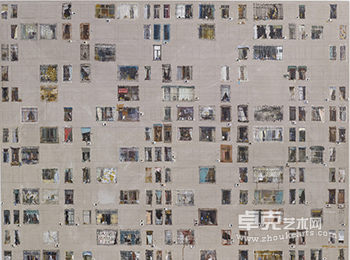
每时每刻,大城市的胜利扩张高歌猛进仿佛永无尽头,平面的规划图变成了垂直的效果图,打开窗子我们与我们的邻居近在咫尺,城市失去了纵深,还不止失去了隐私,空间被压缩成了一堵墙。我们没有在杜海军的垂直城市中看到概念化的欧美城市人的陌生与孤独,相反,骚动其中的是我们自己,是我们已然习焉不察的鼎沸人声,一个个洞开的窗口,一个个拉开幕布的舞台,那儿的活动变人形正是我们自己的日常镜像。
最私人的生活依然如此喧嚣,戏剧性无休止地涌入窗内——拥塞、混乱、无序,那蜂房般的公寓那蜂蝇般的芸芸众生,由于视觉经验的限度,杜海军关注的城市在它的基层结构,裸露的住宅与办公楼,那些如苔藓般滋长外貌具有明显同一性的房子,它们充分地格栅化,雷同,去个性,无限拷贝,它们就像阿西莫夫科幻小说中所描绘的未来人类居所——抽屉,尚可幸运的是,我们今天居住的抽屉还筑造在大地之上,阿西莫夫计划的抽屉将营建于海洋深处。 画家的任务就是呈现,存在对他的全部秘密诱惑即在于拽住一个世界表象,然后不依不饶地描绘它,直到他的画中世界和现实世界平行。杜海军现在还不是一个对城市具有形而上学思考的画家,如同十九世纪法国的外省年轻人初次来到巴黎,除了宏观地被城市外观的扩张所震惊,他更容易被这座城市的光怪陆离紧紧地吸引:细节的晕眩,移花接木的快感,偷换名画置于自己的作品内部,浓缩的日常戏剧,省略,遮掩,裸露,热闹,乏味,游戏,荒诞,这一切不知昼夜地发生在此时此刻的喜剧并非杂乱无章,相反,海军这些在无意识中试图描绘一个仅属于他个人寓言的作品系列之强度恰恰在于“微型化”与“连续性”,它从每一扇窗口向我们发出强烈的欲望召唤,并散发出一种额外的虚无光芒——生生不息,却毫无意义,如果一定要争辩这种生存状态有什么意义的话。
福克纳曾经这样泄露作为一个小说家的秘诀:观察、经验、想象——那么作为画家的杜海军呢,你是不是已经同时兼具了三者,只有上帝知道——我给你的建议是:观察、经验和想象是你画画的基本依据,这些我都看到了,但我还有新的期待,我希望我能在你的未来作品中发现一种属于你的“洞察”。
WHO CAN SEE CITIES
BY WU LIANG
TRANSLATED BY KAIMEI OLSSON WANG
Their inward thought is, that their houses shall continue for ever,and their dwelling places to all generations; they call their lands after their own names. Old Testament, Psalms, 49:11 What is the city over the mountains Cracks and reforms and bursts in the violet air The Waste Land T.S.Eliot The scene is compact, however a void rules its background. Just what is it? A hanging garden? A city within a city? The tower of Babel? A metropolitan generating its own explosion? A future invention for vertical living? Who can see these cities? Who can see the people on the stage? Depth separates a city from a stage. The surfaces of both being lifted and installed in a four-sided frame has now become a painting. In a godless nation where spiritual experience is a rare phenomenon, can we still demand ideals and beliefs? For artists, especially for painters, we should not ask them what they want to express in their paintings, but what we can see in them. The fundamental task of an artist is not to deal with social critique or self-irony, rather it is to deal with those existential dilemma that we all encounter. No one ever asked us if we wanted to be born, but nevertheless we are all cast into this world, gathered in one sphere which we call “the city” .
I ran into Du Haijun quite by accident. Using a quote by John Berger, “we met here”. In 1985, I completed a book called “Notes of Cities”, one of the first book published in China on the theme of urbanization after the country started to open up to the world. 28 years later Haijun is presenting his first solo show entitled “Who Can See Cities?” Despite our accidental encounter and our age difference I still want to believe that our encounter is by all means doomed. The very fact that Haijun's title for the show takes inspiration from Italo Calvino and Saul Bellow makes me believe that on the boundless territory of art and literature everything is connected.
Urbanization has only recently started in this country; yet, its impact and scale have already shocked the world. Looking around us, those pioneers of urbanization have already slowed down their pace. The nineteenth century British politician Benjamin Disraeli famously said, “ urban people don’t know their neighbours“. What he meant by "neighbour" is not just the physical person living next door to you: the neighbour becomes a symbol. German sociologist Georg Simmel coined the word “atom man” to describe the alienated relationships between people living in the modern city: living close to each other but like strangers. As in Kafka and Camus, city folk have been turned into cave men and outsiders in a philosophical sense. Sorry, you must be annoyed by me by now. What do all these concepts about modern city have to do with westerners? Let’s go back to Du Haijun and his paintings. Let’s try to answer his question: who can see cities?
Haijun has been working on his “vertical city” series for seven years. What triggered his ambition to paint these motifs in the first place? There is no one clear answer: could it be his shocking experience as a witness? Or a secret discovery as a voyeur? Or the compulsive obsession as a recorder? Everything is possible. Haijun doesn’t hold the secret of cities. In his works, cities are naked, under surveillance. He did mention the naked city in Calvino’s Invisible Cities and Hitchcock’s Rear Window when we talked. He paints a lot and it feels as if he paints fast as well. The 19 works presented here are only one part of his creation and they give us an impression of a collection of many snapshots. We think of Alain Robbe-Grillet and those cinematographic images that convey “zero degree emotion” in a materialized industrial society. We think of Francois Rabelais' kind of humour and carnivalesque uproar. We also think of the strange combination of post-development aesthetics in our contemporary society. Haijun may have touched these references without consciously choosing them.
Cities are moving constantly. Every minute and every second, the blueprints of cities turn into vertical models. From the windows in our high-rise residences we can peep into our neighbours’ bedrooms. Depth and space have been compressed into a solid wall. In Haijun’s vertical city we don’t feel the solitude and loneliness that usually would be visible in a western cityscape, on the contrary, these paintings express the vibration and life of our city, a hasty, bustling, expanding Chinese city that make us feel nervous and restless. Many things are happening behind the fluttering curtains and inside the opened windows. We are looking at the days of our life.
It is highly paradoxical to think that the most private space in these high-rise residence buildings is simultaneously the most dramatic and chaotic public stage. Their characterless generic looks contain no personal touch. Just like the drawer in Isaac Asimov’s science fiction book about future homes, they are homes for the city dwellers. The only comfort is that our drawer at least still lies on the ground, Asimov had placed his drawer down on the bottom of the ocean.
The main task of a painter is to present the world. Although he may only grasp the surface of this world, for him it may also mean the destined seduction of the universal secret. He keeps on reproducing it in his painting until eventually the world inside his painting becomes parallel with the world he lives in. Haijun’s reflection on the city hasn’t touched the metaphysical layer yet. He is more like a young man from the countryside just arrived in the city. The city for him has the same kind of seduction as Paris had to those provincial artists in the late nineteenth century. To start with, he is knocked out by the expanding mega-size of the city. Gradually he starts to look at the details that embody the everyday life around him. He has learnt to create his own games and found much pleasure in them. All that happens around him: the comic, tragic, boring, exciting, emotional, sad … are after all not that crazy. His works characteristically carry his own storyline. They are like miniatures of life presented through these windows. Each window radiates the seductive imaginary glory that makes us believe life goes on - with or without meaning.
William Faulkner once revealed the secret of being a novelist: you need observation, experience and imagination. How about the secret of being a painter? Does Haijun possessed these three merits? Who knows? Here I want to give Haijun a suggestion: I have seen them, observation, experience and imagination in your paintings. But I have new expectations. I hope you will extend the insight in your art works in the future in a way that is uniquely yours and that only you can do.
上一篇展览:石来运转——张华个人雕塑展
下一篇展览:“笔墨尘缘”冯远中国画作品展
E_mail:zhkarts@vip.163.com 客服电话:18156032908 18155173028 18956011098
版权所有:卓克艺术网 Copyright 2005-2018 zhuoke.cn, All Rights Reserved.
合肥美网文化传播有限公司ICP皖ICP备09018606号-1 皖公网安备 34010402700602号
企业法人营业执照互联网域名注册证书安徽省通信行业暨互联网协会会员单位中国互联网举报中心
客服电话:18156032908 18155173028 18956011098
©2005-2018 zhuoke.cn ICP皖ICP备09018606号-1